Most porch flower displays fail for the same reason: everything sits at one height, in one row, with one type of bloom. The result looks flat, even when the flowers themselves are attractive. Layering solves this, but it also raises practical questions about weather, fading, and maintenance. If you are weighing real plants against long-lasting alternatives such as outdoor artificial flower baskets, the arrangement method matters just as much as the material. This guide walks through a layering approach you can build in an afternoon, along with the trade-offs worth knowing before you commit.
Quick Answer
Create a layered porch display by working in three vertical zones: hanging baskets at eye level or higher, mid-height elements on railings or stands, and grounded planters at the base. Use three to five distinct heights, repeat two or three colors, and vary texture between zones. The most common failure is clustering everything at the same level, which flattens the composition no matter how many flowers you add.
Key Takeaways
- Vertical layering, not plant quantity, is what makes a porch display read as full and intentional.
- Anchor the highest and lowest points first, then fill the middle to balance the visual weight.
- Repeating colors across zones ties the display together; using every color you like usually creates clutter.
- Artificial and live plants can be mixed, but keep artificial material out of direct all-day sun if you want it to last more than one season.
- Porch displays need to survive wind and rain, so secure every hanging element and check drainage on grounded planters.
Start With Height and Structure, Not Flowers
The mistake most people make is buying flowers first and figuring out placement later. Reverse that order. Decide where your display will have visual weight at the top, middle, and bottom before you choose a single bloom. This matters because a porch is viewed from the street or walkway, meaning the display is judged as a silhouette and shape first, and as individual flowers second.
Before placing anything, check three things:
- Available anchor points. Hooks, beams, railing tops, and ceiling overhangs determine what can hang and how high.
- Traffic path. A layered display should not narrow the walkway or block the door swing.
- Sun and wind exposure. The side of a porch facing open sky or prevailing wind will dry out plants, fade fabric, and stress hanging hardware faster than a sheltered corner.
A quick sketch of your porch from the street view, with three horizontal lines marking top, middle, and base, takes five minutes and prevents the most common rework.
Build the Display in Three Vertical Zones
Top Zone: Hanging Baskets and High Anchors
The top zone sets the display’s outline against the house. Hanging baskets work best here because they pull the eye upward and add softness to hard architectural lines. Keep the lowest point of a hanging basket at least six feet above the floor so people can walk under it without ducking.
Vary the drop length rather than hanging every basket at the same height. Two or three different lengths create the layered effect instantly. If your porch has a beam or ceiling, stagger baskets along it; if it only has a single hook, use a bracket that holds two baskets at different heights.
Middle Zone: Railings, Stands, and Window Ledges
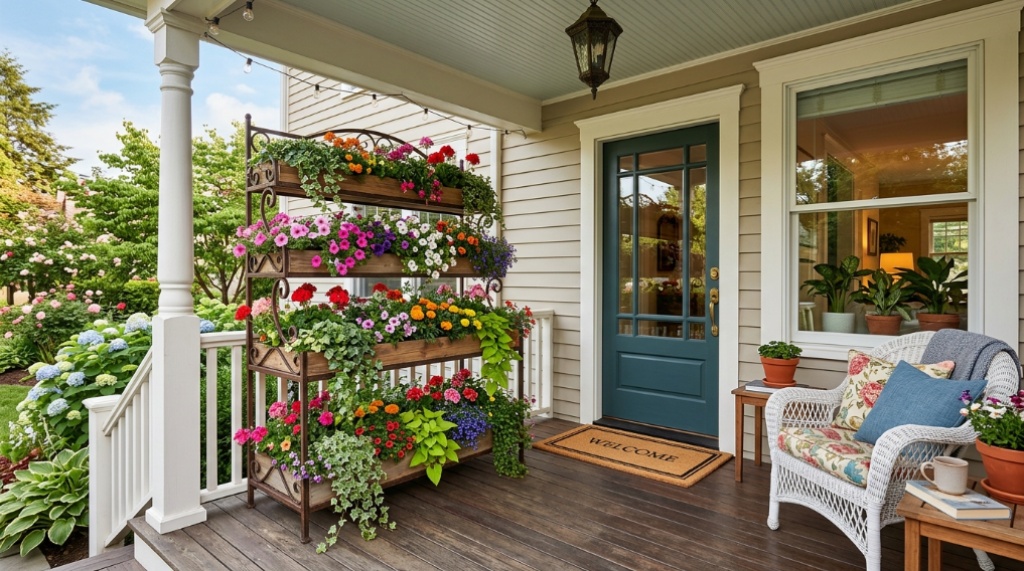
The middle zone is where most displays look empty. This is the height between the hanging baskets and the floor, and it is usually occupied only by a railing. Fill it with:
- Baskets or boxes resting on the railing top
- Tall plant stands or pedestals placed against the wall
- Window boxes if the porch has a visible sill
- A slim tiered shelf or ladder-style planter
This zone is also where the layering effect becomes obvious. Without something here, the hanging baskets above and the planters below read as two separate displays instead of one.
Base Zone: Grounded Planters and Floor Accents
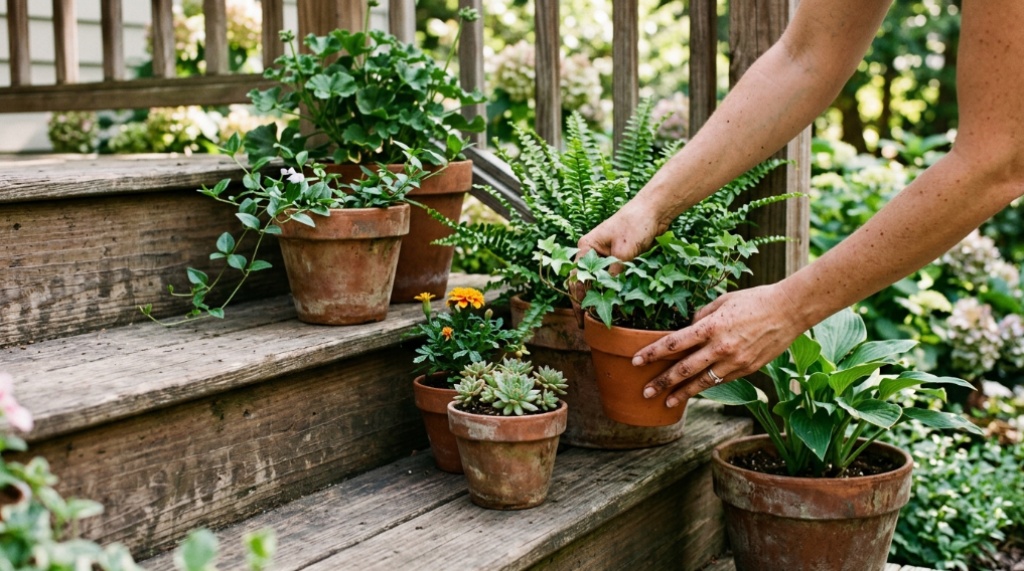
The base zone anchors the composition. Use larger, heavier planters here so the display does not look top-heavy. Group planters in odd numbers, and vary the heights within the group using a mix of pot sizes and small risers. A cluster of three planters at 10, 16, and 24 inches tall reads better than three identical pots in a row.
Choose Colors and Textures That Hold Together
Limit yourself to two or three colors, then repeat each one in at least two different zones. A porch with pink at the top and pink at the base, with green or white in between, looks intentional. A porch with a different color at every level looks like a clearance sale, even if each individual plant is attractive.
Texture does more work than color at a distance. Combine at least three textures across the display:
- Trailing or cascading foliage
- Upright spiky elements
- Rounded or mounded blooms
This mix keeps the display interesting from the sidewalk, where individual flower shapes are not distinguishable but overall form is. When the tallest porch display on the street is also the flattest, it is usually a texture problem, not a flower problem.
Mixing Live Plants and Artificial Flowers
Mixing real and artificial plants in the same display is common and works well, but only if you place them thoughtfully. Artificial material looks most convincing in the top zone, where it is furthest from the eye, and least convincing at floor level, where visitors see it up close. Live plants, meanwhile, handle the base zone better because they can be watered without moving anything overhead.
| Factor | Live Plants | Artificial Flowers |
|---|---|---|
| Watering and upkeep | Regular, varies by season | Occasional dusting |
| Sun fading | Leaves may scorch or drop | Fabric and color can fade over months of direct sun |
| Wind resistance | Flexible stems bend and recover | Stiffer stems may loosen or snap if poorly secured |
| Seasonal change | Changes naturally | Stays consistent until replaced |
| Best placement | Lower zones or shaded spots | Upper zones or sheltered porches |
One practical rule: if a spot gets more than a few hours of harsh afternoon sun, artificial blooms will fade faster than most people expect. Rotating the display, or choosing a sheltered spot for artificial pieces, extends their usable life considerably.
Secure Everything Before the First Windstorm
Porches are wind tunnels. A layered display that looks perfect on a still day can become a hazard in a storm, and a falling basket can crack a railing or injure someone below. Before you consider the display finished:
- Check that every hook is rated for more than the weight of the basket when wet, since soil and water add significant load.
- Use closed hooks or zip ties on hanging baskets rather than open S-hooks, which can bounce free in gusts.
- Weigh down lightweight base planters with stones or sand, or choose heavier containers from the start.
- Tilt hanging baskets slightly inward if the porch is open to the street, so wind pushes them toward the wall instead of away from it.
This is the step most people skip, and it is the one most likely to cost money later, For more creative botanical projects after decorating your entryway, check out our guide on how to use pressed flowers on gifts.
Common Layering Mistakes to Avoid
Several problems show up again and again in porch displays, and each has a straightforward fix:
- All flowers at one height. Add at least two additional levels using stands, brackets, or risers.
- Too many colors. Cut the palette to two or three and repeat them across zones.
- Uniform pot sizes. Vary container heights and widths within each group.
- Symmetry everywhere. Perfect balance looks stiff; offset elements slightly for a more natural result.
- Ignoring the view from inside. Step indoors and look out; the display should read well from both directions.
- No seasonal plan. A display built for spring may look tired by late summer, so plan one swap per season for the most visible elements.
Maintaining the Display Through the Seasons
A layered porch display is not a one-time project unless you choose materials that tolerate neglect. Live elements need water and occasional deadheading. Artificial elements need dust removal and, in sunny spots, replacement or rotation before fading becomes obvious. Hanging hardware should be checked at the start of each season, since metal can loosen, rust, or strip over time.
A useful habit is a short seasonal reset: swap the most visible pieces, check all anchors, and clear any dead foliage. Fifteen minutes twice a year keeps a layered display looking deliberate rather than abandoned, which is the difference between a display that greets visitors and one that just takes up space.
Frequently Asked Questions
How many layers does a porch flower display actually need?
Three distinct levels is the practical minimum: a high hanging tier, a mid-height tier, and a grounded base. Two levels can work on very small porches, but the display will read as sparse rather than layered.
Can I use artificial flowers outdoors year-round?
Yes, but with limits. Artificial blooms in fully sheltered spots can last multiple seasons, while those in direct sun and wind may fade or loosen within a single season. Rotating pieces and using UV-resistant materials extends their life.
What is the best height for hanging baskets on a porch?
Keep the lowest point of any hanging basket at least six feet above the floor so people can walk beneath it comfortably. Varying the drop length between baskets adds visual interest as long as none drop into head height.
Should the colors match across all layers?
Not exactly. Use two or three colors total and repeat each one in at least two zones. This creates cohesion without making every layer identical, which tends to look flat.
How do I keep a layered display from looking cluttered?
Limit your color palette, vary container sizes instead of multiplying them, and leave some empty space between groupings. Clutter usually comes from too many elements at the same height, not from the number of plants overall.
Is it better to buy one large arrangement or several smaller ones?
Several smaller pieces almost always work better for a layered look, because they can be distributed across heights. A single large arrangement tends to occupy only one zone and leaves the others empty.
Conclusion
A layered porch display comes down to structure, not volume. Anchor the top with hanging baskets, fill the mid-height with stands or railing pieces, and ground the composition with heavier planters at the base. Stick to two or three repeated colors, mix textures, and secure everything against wind before the season starts. Whether you use live plants, artificial flowers, or a blend of both, that structure is what makes the display look intentional from the sidewalk. Start with the top and base zones, then fill the middle to tie it together.