You’ve packed the snacks, slathered on the sunscreen, and loaded the kids into the car. But when you arrive at the lake, you realize your paddle board can only hold one person. The day quickly shifts from family bonding to a game of “who gets to go next.” This is the moment you realize that buying the wrong board isn’t just a waste of money—it’s a missed opportunity for connection. The truth is that finding the right inflatable paddle board family adventure requires balancing size, stability, and durability. You need a board that handles a wiggly child, a clumsy dog, and your own need for a solid workout, all without deflating morale.
This guide cuts through the marketing fluff. We break down exactly what to look for so that your next purchase turns solo paddling into shared memories on the water.
Why Choose an Inflatable Paddle Board Over a Hard Board for Family Use?
Inflatable boards are safer for families because they are softer, significantly lighter, and much easier to transport than rigid epoxy boards. While hard boards offer better speed and glide for racing, they are a hazard to small children and car roofs alike. For a family day out, the inflatable option wins for three primary reasons: safety, storage, and setup time.
When a toddler falls off the board, hitting the soft PVC is much gentler than hitting a fiberglass shell. Furthermore, an inflatable board rolls up into a backpack that fits in the trunk of a sedan, leaving room for the cooler and the stroller. Most family-oriented boards inflate in under ten minutes, meaning less time prepping and more time paddling.
Key Safety Advantages for Kids
- Soft Deck: Reduces injury risk if a child slips or falls.
- Buoyancy: Provides a stable platform for kneeling or standing.
- Weight: A 20-pound board is easy for a parent to carry while holding a child with the other hand.
What Size Inflatable Paddle Board Is Best for a Family of Four?
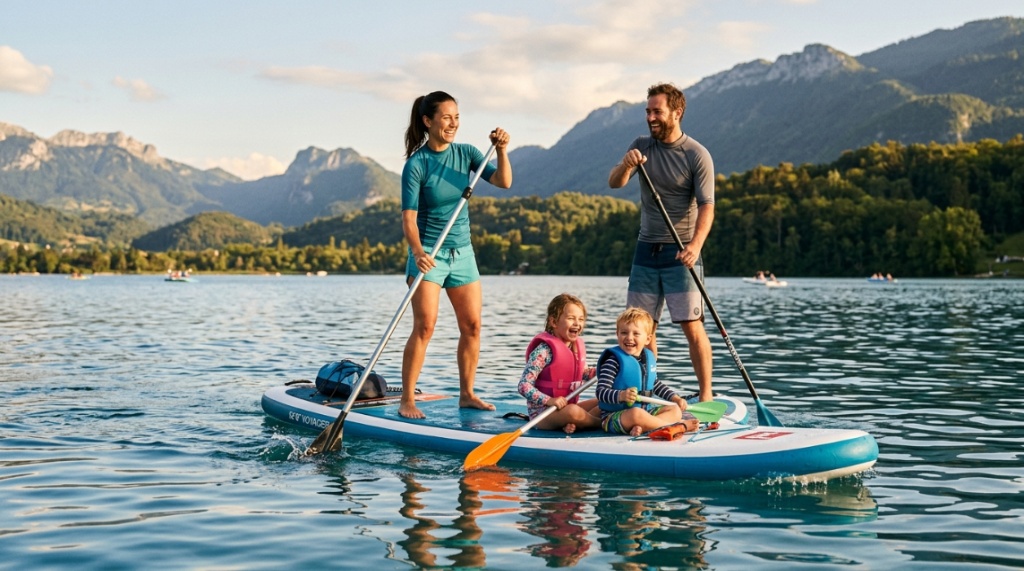
For a family of four, you likely need two separate boards: one large touring board (11’6” to 12’6”) for a parent plus one child, and a smaller all-around board (10’6”) for the other parent. There is no single board that comfortably holds four people. The ideal strategy is to invest in a multi-board solution rather than one giant raft.
A single 12-foot board is excellent for carrying a parent and a small child sitting on the nose, but it becomes unstable with more than two people. Volume is the critical metric here. Look for boards with at least 300 liters of volume if you plan to regularly carry a child. The width should be 32 to 34 inches for maximum stability. Anything narrower than 30 inches will feel tippy with a passenger.
Recommended Board Sizes by Family Size
| Family Setup | Recommendation | Width Min. |
|---|---|---|
| 2 Adults + 1 Toddler | 1 board (12’ x 34”) | 32” |
| 2 Adults + 2 Kids | 2 boards (11’6” + 10’6”) | 32” |
| 1 Adult + 2 Kids | 1 board (12’6” x 35”) | 34” |
How Much Weight Capacity Do You Actually Need?
The weight capacity of the board must be at least 50 pounds more than the combined weight of the paddlers, gear, and a safety margin for water splashing. Most manufacturers list a maximum capacity, but you should aim for about 70% of that number for optimal performance. For example, if you and your child weigh 200 lbs combined, look for a board rated for at least 280–300 lbs.
Exceeding the weight limit makes the board sluggish, hard to steer, and prone to nose-diving into waves. A heavier load also reduces freeboard (the height of the deck above the water), making it easier for water to wash over the board. For a family trip, bring less gear and prioritize board performance. A fully loaded board is a slow board.
Weight Calculation Formula
- Add your weight + child’s weight + dog’s weight + 15 lbs for gear.
- Add 20% of that total as a safety buffer.
- Search for boards exceeding that final number.
Which Board Construction Materials Last Longer for Family Abuse?
Look for boards made with dual-layer PVC (Polyvinyl Chloride) using a drop-stitch core. The best family boards use military-grade PVC with a density of 1,000 denier or higher. This material resists punctures from rocks, dog claws, and dropped beach toys. Single-layer PVC is cheaper but will delaminate or warp after a few seasons of rough family use.
The construction quality is determined by the number of layers and the glue used. High-quality boards feature a PVC rail band that reinforces the edges—the most common failure point. Avoid boards that feel “spongy” when fully inflated. A good board should feel like a solid plank, not a pool float. If you plan on letting the kids jump off the board into the water, invest in a board with a reinforced standing area.
Construction Quality Checklist
- Drop-Stitch Core: Ensures rigidity at high PSI.
- Double Layer Fusion: More durable than single layer glue.
- Reinforced Rails: Prevents edge wear from docks and sand.
- UV Coating: Prevents sun damage if left on the beach.
What Features Make a Board Kid-Friendly and Dog-Friendly?
A board is family-friendly when it has a soft non-slip deck pad covering at least 70% of the surface, multiple D-rings for attaching a cooler or safety leash, and bungee cargo storage at the nose. For dogs and kids, the deck pad needs to be thick EVA foam to provide traction when wet. Slippery boards lead to falls and tears.
Look for boards with a centered handle that allows a child to hold on while being towed. A rounded nose (rather than a sharp racing point) is safer for accidental bumping. Additionally, a board with at least three fin boxes offers better tracking stability, which is helpful when kids paddle erratically. For dogs specifically, a board with a textured traction pad (similar to a yoga mat) helps them grip better than a slick surface.
Essential Features for Kids
- Full-length traction pad.
- Bungee tie-downs for snacks and dry bags.
- Center carry handle for easy carrying by adults.
- Molded-in cup holder (surprisingly useful for child’s juice box).
How Long Does It Take to Inflate and Deflate at the Beach?
Using a quality dual-action hand pump, a 12-foot board takes between 8 and 15 minutes to reach the recommended PSI (usually 15 PSI). An electric pump cuts that down to 5 to 7 minutes. For a family outing, a portable electric pump is a worthwhile investment because it saves your energy for paddling. Deflation takes about 2 minutes using the valve’s rapid deflate mode.
The trick to fast inflation is understanding PSI (pounds per square inch). Do not guess. Most boards have a PSI rating printed near the valve. Under-inflating makes the board wobbly and sluggish; over-inflating risks seam damage. A good rule of thumb: inflate to 80% using a hand pump, then use the final pump strokes to hit the target PSI. If you are raw dogging it with a cheap hand pump, you will be tired before you hit the water.
Pump Recommendation
- Manual: Dual-action (pumps on both up and down strokes).
- Electric: 12V car adapter with auto shut-off at PSI target.
Is a 6-Inch Thick Board Better Than a 4-Inch for Families?
Yes, for family use, a 6-inch thick board is significantly better. Standard inflatable boards are 4 to 6 inches thick. The extra thickness provides more rigidity and weight capacity. A 6-inch board supports heavier loads without folding in the middle, which is critical when you have a child standing near the nose while you paddle at the tail.
A 4-inch board is fine for a solo adult under 180 lbs, but it flexes noticeably under the weight of two people. Flexibility reduces speed and efficiency. For a family board, seek 6-inch thickness. This thickness also gives you more freeboard, keeping the deck drier when the water gets choppy from passing boats or wind.
If your family adventures lean more toward catching dinner than just paddling around, you might also want to check out our guide on choose a fish finder for kayak fishing to upgrade your next trip.
Can You Use a Family Paddle Board for Solo Adult Paddling?
Absolutely, but you must accept a trade-off in speed and handling. A wide, thick board designed for families is slower and harder to turn than a narrow touring board. However, it provides an incredibly stable platform for yoga, fishing, or just floating. For the solo parent who rarely gets to paddle alone, this stability is often a welcome change from a wobbly race board.
If you buy a family-oriented board, you are optimizing for fun and safety over performance. When paddling solo, you will notice the board tracks straight easily but requires more effort to turn. This is fine for leisurely lake paddling but frustrating for surfing waves or long-distance touring. If you plan to share the board 50/50 between solo and family use, prioritize stability over speed.
How Much Should You Spend on a Family Inflatable Paddle Board?
A quality family inflatable paddle board costs between $500 and $900. Anything under $400 usually lacks the essential features like high-density drop-stitch, decent PSI rating, and reliable valves. You are paying for durability and safety. A cheap board that pops on its second outing is not a bargain—it is a hazard.
Mid-range boards ($500–$700) offer the best value for families. They include dual-layer PVC, a comfortable padding kit, and a decent pump. Premium boards ($800+) use lighter materials or advanced welding technology, but the extra cost is not always necessary unless you plan to paddle 30+ miles per week. The key is to avoid the “wish.com specials” that use thin PVC material that delaminates under summer heat. For a reliable list of tested options, checking a curated source for the best inflatable paddle board family choices can help you avoid wasting money on disposable gear.
Price vs. Quality Breakdown
| Price Range | Quality Level | Suitability for Family |
|---|---|---|
| Under $400 | Entry / Poor | Not recommended (failure risk) |
| $500 – $700 | Good / Reliable | Excellent for weekend use |
| $800 – $1,200 | Premium | Excellent for heavy use |
What Essential Accessories Do You Need for a Family Day on the Water?
Beyond the board itself, you need a coiled leash (not a straight leash), a personal flotation device (PFD) for every child, a waterproof phone case, and a high-quality repair kit. Many boards come as a package, but the included accessories are often poor. The pump that comes with a cheap board is usually slow and hard to use. Replace it early.
For kids, a life jacket that is USCG approved and fits snugly is non-negotiable. A leash should be attached to the board, not your ankle, when kids are aboard. This prevents the board from drifting away if everyone falls off. Also, bring a dry bag with a change of clothes and towels. A family day on the water includes spills and splashes. Finally, sun protection (UPF clothing and reef-safe sunscreen) is essential, as reflected UV from the water can burn exposed skin quickly.
Conclusion
Choosing an inflatable paddle board for family fun is about prioritizing stability, durability, and safety over high-speed performance. Look for a board that is at least 11 feet long, 32 inches wide, and 6 inches thick, with a weight capacity 50 pounds above your combined family weight. Focus on dual-layer PVC construction and a full-length traction pad. While no single board can replace a fleet, a well-chosen 12-foot board can comfortably carry a parent and a child, turning a simple paddle into a lasting memory. Remember that the accessories matter as much as the board, especially when it comes to safety gear for kids. Do your research, buy quality, and get out on the water this weekend.
Frequently Asked Questions
Can a 2-year-old ride on an inflatable paddle board?
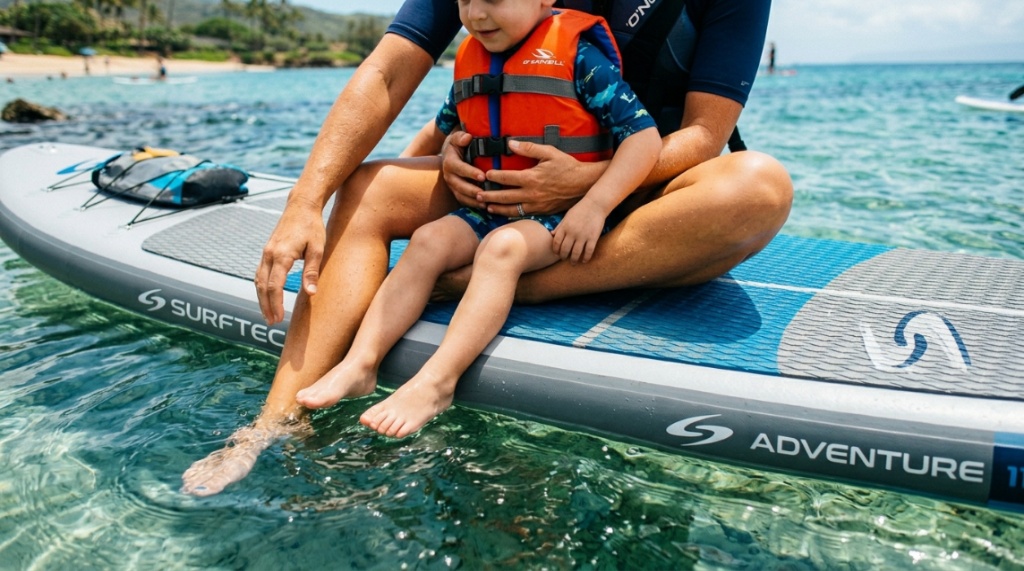
Yes, but they must wear a properly fitted life jacket and sit between your legs. Use a board with a large, soft deck pad for comfort and stability.
How many people can fit on a standard 10’6” inflatable board?
A 10’6” board is best for one adult plus a small child under 50 lbs. Two adults will make the board unstable and hard to paddle.
Is it safe to take a dog on an inflatable paddle board?
Yes, but you need a board with a high-weight capacity, a textured traction pad, and a dog-specific life jacket. Introduce the dog on land first.
How do I store an inflatable paddle board during the winter?
Clean and dry it completely. Deflate and roll it loosely. Store in a cool, dry place away from direct sunlight and freezing temperatures.
What PSI should I inflate a family paddle board to?
Most family boards require 12 to 15 PSI. Inflate to the maximum recommended PSI printed on the board to ensure rigidity and prevent flexing.
Can kids use the electric pump by themselves?
No. While the pump is easy to use, adult supervision is required to avoid overheating the pump or over-inflating the board.
How do I clean a paddle board after lake use?
Rinse with fresh water, use mild soap for stains, and dry thoroughly before storing. Avoid harsh chemicals that can degrade the PVC.