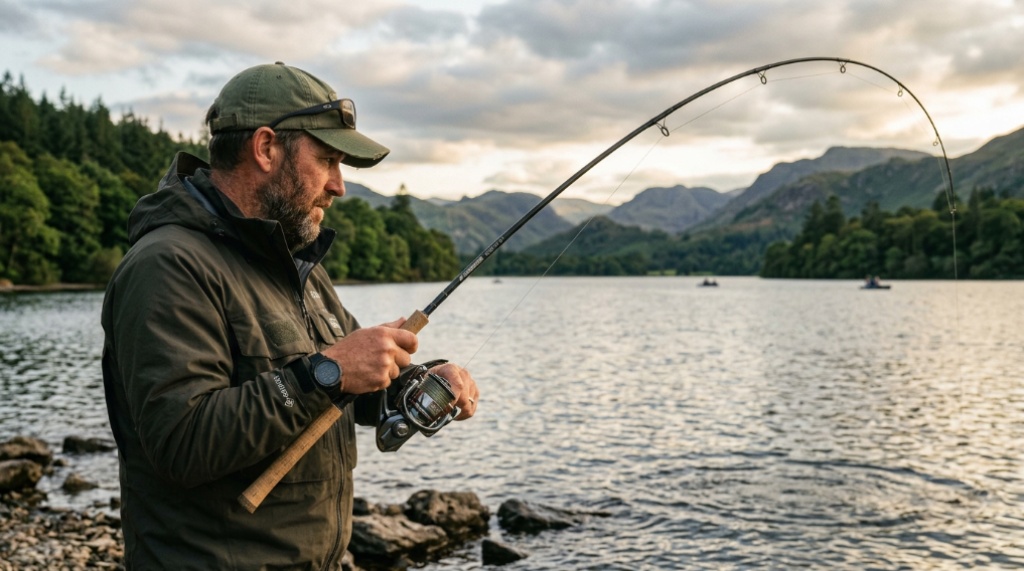
Two anglers stand on the same bank, throwing the same lure at the same fish. One casts accurately all afternoon; the other keeps missing the strike or losing fish at the net. Often the difference isn’t skill — it’s that one rod is 6’6″ medium-fast and the other is 7’6″ heavy. Length and action quietly decide how far you cast, how well you set a hook, and how much control you keep when a fish makes a run. If you’re already comparing specific setups, such as a Plusinno carbon fiber combo, check this review before you buy — the listed length and action usually reveal more about a rod’s real job than any marketing description.
Quick Answer
Rod length mainly controls casting distance, leverage, and line control, while action controls how far down the blank bends and how quickly it returns to straight. A longer rod casts farther and manages line better; a shorter rod is more accurate and easier to work in tight cover. A fast action bends near the tip, giving quick hooksets and sensitivity, while a moderate action bends deeper, protecting light line and keeping hooked fish pinned. Match both to your lure weight, target species, and fishing environment.
Key Takeaways
- Length affects distance, leverage, and line management; action affects hookset speed, sensitivity, and fish-fighting forgiveness.
- A fast-action rod is not automatically “better” — it excels for single-hook lures and jigging but can tear hooks free on treble-hook baits.
- Longer rods cast farther but are harder to cast accurately and awkward in kayaks, canoes, or brushy banks.
- Rod power (light, medium, heavy) is a separate rating from action, and confusing the two is one of the most common buying mistakes.
- Match the rod’s lure weight range to what you actually throw, or performance drops regardless of length and action.
What Rod Length Actually Changes on the Water
Length is the most visible spec, but its effects are mechanical rather than cosmetic. A longer blank gives you more leverage on a hookset, more reach when steering a fish around cover, and more line off the water during a cast. Those advantages come with trade-offs in accuracy, weight, and maneuverability.
Distance and accuracy
Extra length increases tip speed during the cast, which generally translates to more distance — all else being equal. But accuracy tends to suffer because a longer rod amplifies small errors in your casting stroke. If you’re pitching a jig under a dock or dropping a bait beside a stump, a 6’6″ or 6’10” rod usually beats a 7’6″ rod for precision.
Leverage and fish control
A longer rod lets you move a fish with less effort and keeps your line clear of the boat, rocks, or submerged timber. That matters when you’re fighting a fish that wants to dive into structure. Shorter rods give you less leverage but more direct, immediate control in close quarters.
Practical length ranges
- 5’6″–6’0″: Small creeks, kayaks, ice fishing, kids’ setups, tight cover.
- 6’6″–7’0″: The general-purpose middle ground — bass, walleye, trout, inshore work.
- 7’0″–7’6″: Shore and surf casting, finesse techniques, longer-distance presentations.
- 8’0″ and up: Surf, steelhead, salmon, and specialty techniques where reach and distance dominate.
Rod Action Explained Without the Marketing Jargon
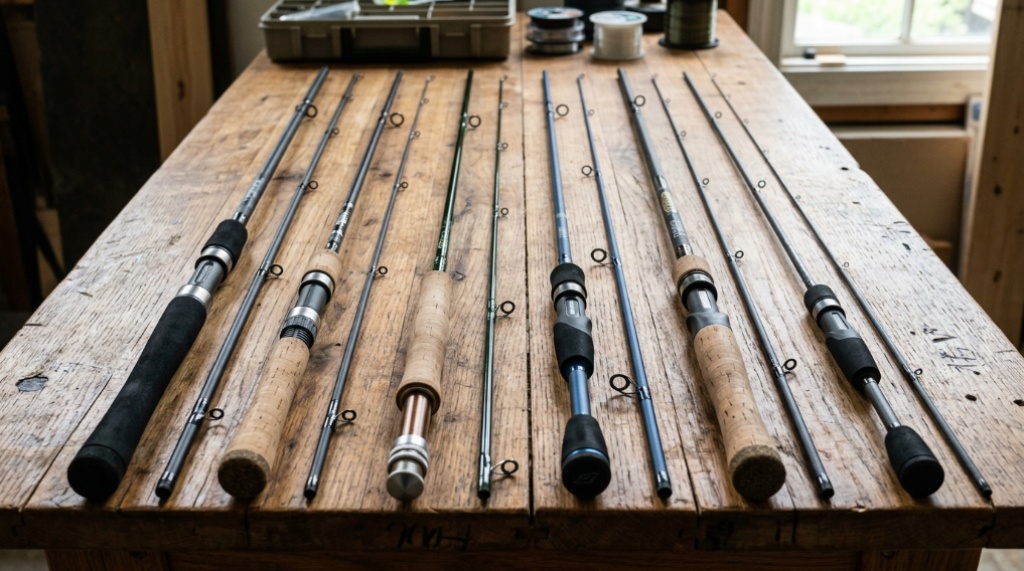
Action describes where the rod bends under load. A fast rod bends mostly in the top third; a moderate or slow rod bends progressively deeper into the mid and lower sections. Manufacturers use terms like “fast,” “extra fast,” “moderate-fast,” and “moderate,” but the practical meaning is simple: how much of the rod is working when you pull.
Fast action
Fast rods load quickly and snap back fast. You get crisp hooksets, better sensitivity for detecting soft bites, and more precise lure control. They’re ideal for jigs, Texas-rigged plastics, drop-shot rigs, and any technique requiring a firm, single-hook hookset. The downside: a stiff tip can rip treble hooks out of a fish’s mouth during the fight, and it offers less cushion on light line.
Moderate and moderate-fast action
These bend deeper and act like a shock absorber. They keep tension on the fish during head shakes, protect light line, and work well with crankbaits, spinnerbaits, and topwater lures where treble hooks are involved. They sacrifice a bit of sensitivity and hookset speed, which is a fair trade in many situations.
Slow action
Slow-action rods bend almost to the handle. They’re less common today and mostly used for specific applications like fishing with live bait or certain fly-fishing styles where a soft, forgiving feel matters more than responsiveness.
How Length and Action Interact
These two specs don’t operate independently. A 7’6″ fast-action rod behaves very differently from a 6’0″ fast-action rod, even though both are labeled “fast.” The longer rod gives more leverage and reach; the shorter one feels quicker and more direct. The table below summarizes the practical differences.
| Rod Spec | Primary Effect | Best For | Trade-Off |
|---|---|---|---|
| Long + fast | Distance with crisp hooksets | Shore casting, jigging, finesse | Less accurate, harder in tight spaces |
| Long + moderate | Distance with forgiveness | Crankbaits, surf, live bait | Slower hookset, heavier feel |
| Short + fast | Precision and quick response | Kayak, docks, pitching | Limited casting distance |
| Short + moderate | Control and shock absorption | Small creeks, treble-hook lures | Less leverage on big fish |
Matching Rod Specs to Your Fishing Situation
The right combination depends less on personal preference than on where and how you fish. A few practical pairings:
- Bass in heavy cover: 7’0″–7’6″ heavy power, fast action. You need leverage to pull fish out of grass and wood.
- Crankbaits and treble-hook lures: 7’0″–7’6″ medium power, moderate action. The softer bend keeps hooks from tearing free.
- Trout in small streams: 5’6″–6’6″ light power, fast or moderate-fast action. Short rods cast accurately around brush.
- Surf and shore fishing: 9’0″–11’0″ medium-heavy, moderate-fast action. Distance and line control matter more than sensitivity.
- Kayak and canoe: 6’6″–7’0″ medium power, fast action. Long enough to cast, short enough to manage while seated.
Common Mistakes That Cost You Fish
Most rod-related problems come from mismatches rather than bad equipment.
- Confusing power with action. Power is how much force it takes to bend the rod (light, medium, heavy); action is where it bends. A medium-power fast-action rod and a medium-power moderate-action rod are very different tools.
- Buying the longest rod you can afford. Extra length only helps if you need distance or leverage. In a kayak or a brushy creek, it becomes a liability.
- Using a fast rod for treble-hook baits. The stiff tip loads fast and can pull hooks loose on head-shaking fish.
- Ignoring the lure weight range. A rod rated for 1/4–3/4 oz will feel dead and won’t load properly if you’re throwing a 1/8 oz bait.
- Assuming a stiffer rod means better sensitivity. Sensitivity comes from blank material, construction, and how the rod balances in your hand — not from action alone.
Does a Longer Rod Always Cast Farther?
No. Length helps, but only when the rod loads properly with the lure you’re throwing. An 8-foot rod rated for 1–3 oz will cast a 1/4 oz lure poorly, while a well-matched 6’6″ rod can outcast it easily. Technique, line type, reel spool design, and lure aerodynamics all matter. Length is one factor among several, not a guarantee.
There’s also a practical ceiling. Beyond a certain point, extra length adds weight and reduces control without meaningful distance gains for most freshwater applications. For inshore and surf fishing, longer rods are genuinely useful because you’re often casting heavier payloads into wind and need to keep line above the breakers, Before heading out onto the water, make sure you also read our guide on how to choose a fish finder for kayak fishing to upgrade your electronics setup.
Balancing Rod Specs With Reel and Line
A rod’s length and action only perform as designed when paired with appropriate tackle. A fast-action rod paired with a heavy, slow reel feels tip-heavy and tiring. A moderate-action rod with a very fast, high-gear-ratio reel can feel disconnected.
Line type matters too. Braid has almost no stretch, so a moderate-action rod becomes the only shock absorber in the system — which is often exactly what you want with treble hooks. Monofilament and fluorocarbon stretch, so a fast-action rod with mono can feel softer than expected while still delivering a firm hookset.
If you’re building a setup from scratch, choose the rod first based on technique and environment, then match the reel size and line to the rod’s ratings rather than the other way around.
Frequently Asked Questions
Is a fast-action rod better than a moderate-action rod?
Neither is universally better. Fast action suits single-hook lures, jigging, and finesse techniques where sensitivity and quick hooksets matter. Moderate action suits treble-hook lures and light line where forgiveness prevents hooks from pulling free. The right choice depends on your technique.
What rod length is best for beginners?
A 6’6″ to 7’0″ medium-power, fast-action spinning rod covers the widest range of freshwater situations. It’s long enough to cast reasonably well, short enough to handle comfortably, and versatile enough for most common techniques.
Can I use a long rod in a kayak?
Yes, but it becomes awkward. Most kayak anglers prefer 6’6″ to 7’0″ rods because they’re easier to manage while seated and less likely to snag on surrounding vegetation or the kayak itself. Rods over 7’6″ are rarely practical from a seated position.
Does rod action affect how much I can feel a bite?
It contributes, but it isn’t the only factor. A fast-action rod transmits vibration more directly because the tip is stiffer. However, blank material, guide quality, line type, and how the rod balances in your hand often matter just as much for bite detection.
How do I know if a rod is loaded properly during a cast?
You should feel the rod bend against the weight of the lure during the backcast and unload smoothly on the forward stroke. If the rod feels stiff and lifeless, the lure is too light. If it feels mushy or overloaded, the lure is too heavy for the rod’s rating.
Should I match rod length to my height?
Not directly, but height affects comfort. A very tall angler may find short rods feel cramped, while a shorter angler may struggle to generate tip speed with an 8-foot surf rod. Comfort and casting mechanics matter more than any height-based rule.
Conclusion
Rod length and action aren’t abstract specs — they determine how far you cast, how quickly you set the hook, and how much forgiveness you get when a fish fights back. Start with your technique and environment, then choose length for reach and distance, action for hookset speed and fish-fighting behavior, and power for the weight you’re throwing. Get those three aligned, and the rod stops being a variable you fight against and becomes a tool that quietly does its job.